The Off-Modern: Psychology Estranged by Ron Roberts
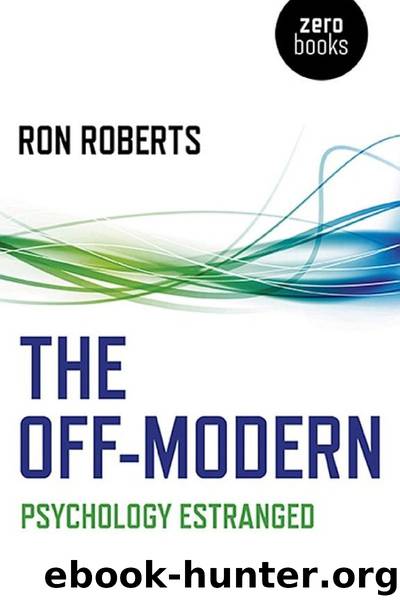
Author:Ron Roberts [Roberts, Ron]
Language: eng
Format: epub
Tags: Psychology, Social Psychology, Psychotherapy, General, Business & Economics, Economics
ISBN: 9781785355967
Google: fCI0DwAAQBAJ
Amazon: B075DKKYN7
Goodreads: 36820857
Publisher: Zero Books
Published: 2017-09-28T23:00:00+00:00
Five
Estrangement, Psychotherapy and Counselling
My tears are like the quiet drift
Of petals from some magic rose;
And all my grief flows from the rift
Of unremembered skies and snows
– Dylan Thomas (2003, p.258)
There is no better start to thinking than laughter
– Walter Benjamin (2007, p.236)
The Therapeutic Encounter
Since Freud’s day the types and varieties of psychotherapy – along with its erstwhile and indistinguishable cousin, counselling – have multiplied. Accompanying this seemingly endless expansion has been an explosion of research seeking to pinpoint exactly what it is about the process of psychotherapy that is responsible for producing effective change in the lives of clients. With regard to this goal, some commentators (e.g. Stratton, 2015) have questioned the usefulness of a research paradigm rooted in the natural sciences, which invites a transformation of the therapeutic human encounter into a series of identifiable and quantifiable variables whose precise effects can be teased out through careful and deliberate external control. Without denying that some of this research has been useful, the most frequently cited results from it point to the chief “ingredient” being the nature of the relationship between client and therapist – which returns us to the question of what it is that makes human relationships worthwhile and cherishable; what enriches our lives in any encounter with another person? This is the flipside of the coin to the dark matter of what diminishes and damages our lives with others.
Rather than revisiting, then, the main alleyways and byways of the psychotherapeutic research literature, I wish to adopt a different perspective, that we may literally see psychotherapy differently – a lateral move on my part to reconfigure perception of the business and practice of psychotherapy. One of the assumptions at the forefront of psychotherapy research is that it involves the application of some esoteric skill – embodied and cultivated in the therapist, accumulated through years of training and supervision – which works upon the individual who has sought help. Like a matryoshka doll, this assumption itself contains another: that the iron test of whether psychotherapy is a worthy endeavour depends on there being an outcome, an endpoint that can be considered successful – that in some way our suffering has been relieved and we can be said to “feel” better. Nested within this is yet another assumption: that psychotherapy is quite unlike real life and is best considered separate from it. This is probably due in some small part to the fact that we enter the world without formal or practical knowledge of human relationships and most of us go through life without receiving any.
My starting point is to hold all these assumptions in abeyance and to rethink the contours of fruitful human relationships. In referring to fruitfulness, care must be taken not to fall prey to the Manichean ideas of outcome found in the research literature, suggesting a clear determinable “positive” consequence. I have in mind nothing more than how to live well – the age-old question posed by Aristotle, which it need hardly be said does not suggest a clear specifiable consequence.
Download
This site does not store any files on its server. We only index and link to content provided by other sites. Please contact the content providers to delete copyright contents if any and email us, we'll remove relevant links or contents immediately.
Rewire Your Anxious Brain by Catherine M. Pittman(18711)
Talking to Strangers by Malcolm Gladwell(13439)
The Art of Thinking Clearly by Rolf Dobelli(10598)
Mindhunter: Inside the FBI's Elite Serial Crime Unit by John E. Douglas & Mark Olshaker(9420)
Becoming Supernatural by Dr. Joe Dispenza(8277)
Change Your Questions, Change Your Life by Marilee Adams(7847)
Nudge - Improving Decisions about Health, Wealth, and Happiness by Thaler Sunstein(7758)
The Road Less Traveled by M. Scott Peck(7662)
The Lost Art of Listening by Michael P. Nichols(7547)
Mastermind: How to Think Like Sherlock Holmes by Maria Konnikova(7431)
Enlightenment Now: The Case for Reason, Science, Humanism, and Progress by Steven Pinker(7354)
Win Bigly by Scott Adams(7256)
The Way of Zen by Alan W. Watts(6670)
Daring Greatly by Brene Brown(6557)
Big Magic: Creative Living Beyond Fear by Elizabeth Gilbert(5833)
Grit by Angela Duckworth(5673)
Ego Is the Enemy by Ryan Holiday(5527)
The Laws of Human Nature by Robert Greene(5325)
Men In Love by Nancy Friday(5292)
